Periodic Poisson solve on non-Cartesian quadrature grid (Python)
This is a Python translation of this MATLAB tutorial.
It is standard to use the FFT as a fast solver for the Poisson equation on a periodic domain, say \([0,2\pi)^d\). Namely, given \(f\), find \(u\) satisfying
which has a unique solution up to constants. When \(f\) and \(u\) live on a regular Cartesian mesh, three steps are needed. The first takes an FFT to approximate the Fourier series coefficient array of \(f\), the second divides by \(\|k\|^2\), and the third uses another FFT to evaluate the Fourier series for \(u\) back on the original grid. Here is a Python demo in \(d=2\) dimensions. First, we have to import some packages:
import finufft
import numpy as np
np.seterr(divide='ignore')  # Disable division by zero warning
from matplotlib.colors import CenteredNorm
import matplotlib.pyplot as plt
Then, we set up a smooth function, periodic up to machine precision:
w0 = 0.1 # width of bumps
src = lambda x, y: np.exp(-0.5*((x-1)**2+(y-2)**2)/w0**2)-np.exp(-0.5*((x-3)**2+(y-5)**2)/w0**2)
Now we do the FFT solve, using a loop to check convergence with respect to
n the number of grid points in each dimension:
for n in range(40, 120 + 20, 20):               # convergence study of grid points per side
    x = 2*np.pi*np.arange(n) / n                # grid
    xx, yy = np.meshgrid(x, x)                  # ordering: x fast, y slow
    f = src(xx,yy)                              # eval source on grid
    fhat = np.fft.ifft2(f)                      # step 1: Fourier coeffs by Euler-F projection
    k = np.fft.fftfreq(n) * n                   # Fourier mode grid
    kx, ky = np.meshgrid(k, k)
    kfilter = 1. / (kx**2 + ky**2)              # -(Laplacian)^{-1} in Fourier space
    kfilter[0, 0] = 0                           # kill the zero mode (even if inconsistent)
    kfilter[n//2, :] = 0
    kfilter[:, n//2] = 0                        # kill n/2 modes since non-symm
    u = np.fft.fft2(kfilter * fhat).real        # steps 2 and 3
    print(f"n={n}:\t\tu(0,0) = {u[0,0]:.15e}")  # check conv at a point
We observe spectral convergence to 14 digits:
n=40:         u(0,0) = 1.551906153625019e-03
n=60:         u(0,0) = 1.549852227637310e-03
n=80:         u(0,0) = 1.549852190998226e-03
n=100:        u(0,0) = 1.549852191075839e-03
n=120:        u(0,0) = 1.549852191075829e-03
Here we plot the FFT solution:
fig, ax = plt.subplots(1, 2, figsize=[10, 4], dpi=150)
imshow_args = {"origin": "lower", "cmap": "jet", "extent": [0.0, 2.*np.pi, 0.0, 2.*np.pi]}
cax = ax[0].imshow(f, **imshow_args)
fig.colorbar(cax, ax=ax[0])
ax[0].set_xlabel("$x$")
ax[0].set_ylabel("$y$")
ax[0].set_title("source term $f$")
cax = ax[1].imshow(u, **imshow_args)
fig.colorbar(cax, ax=ax[1])
ax[1].set_xlabel("$x$")
ax[1].set_ylabel("$y$")
ax[1].set_title("FFT solution $u$")
plt.savefig("pois_fft_python.png")
fig.tight_layout()
plt.show()
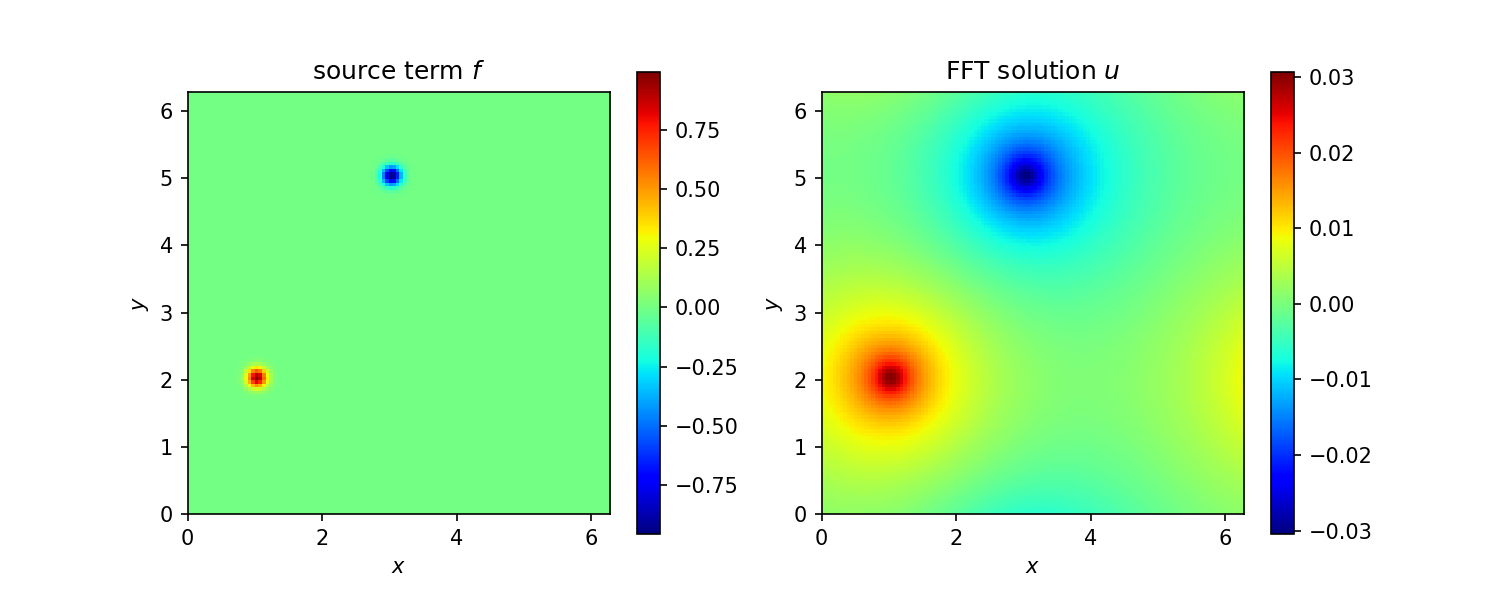
Now let’s say you wish to do a similar Poisson solve on a non-Cartesian grid covering the same domain. There are two cases: a) the grid is unstructured and you do not know the weights of a quadrature scheme, or b) you do know the weights of a quadrature scheme (which ususally implies that the grid is structured, such as arising from a different coordinate system or an adaptive subdivision). By quadrature scheme we mean nodes \(x_j \in \mathbb{R}^d\), \(j=1,\dots, M\), and weights \(w_j\) such that, for all smooth functions \(f\),
holds to sufficient accuracy. We consider case b) only. For demo purposes, we use a simple smooth diffeomorphism from \([0,2\pi)^2\) to itself to define a distorted mesh (the associated quadrature weights will come from the determinant of the Jacobian):
deform = lambda t, s: np.stack([t + 0.5*np.sin(t) + 0.2*np.sin(2*s), s + 0.3*np.sin(2*s) + 0.3*np.sin(s-t)])
deformJ = lambda t, s: np.stack([
    np.stack([1 + 0.5*np.cos(t), 0.4*np.cos(2*s)], axis=-1),
    np.stack([-0.3*np.cos(s-t), 1+0.6*np.cos(2*s)+0.3*np.cos(s-t)], axis=-1)
], axis=-1) # its 2x2 Jacobian
For convenience of checking the solution against the above one, we chose the map to take the origin to itself. To visualize the grid, we plot \(f\) on it, noting that it covers the domain when periodically extended:
t = 2 * np.pi * np.arange(n) / n           # 1d unif grid
tt, ss = np.meshgrid(t, t)
xxx = deform(tt, ss)
xx, yy = xxx[0], xxx[1]
f = src(xx, yy)
fig, ax = plt.subplots(1, 1, figsize=[4, 4], dpi=150)
cax = ax.pcolormesh(xx, yy, f, shading='gouraud', cmap="jet", norm=CenteredNorm())
ax.set_title("$f$ on mesh")
ax.axis("equal")
plt.savefig("pois_nugrid_python.png")
plt.show()
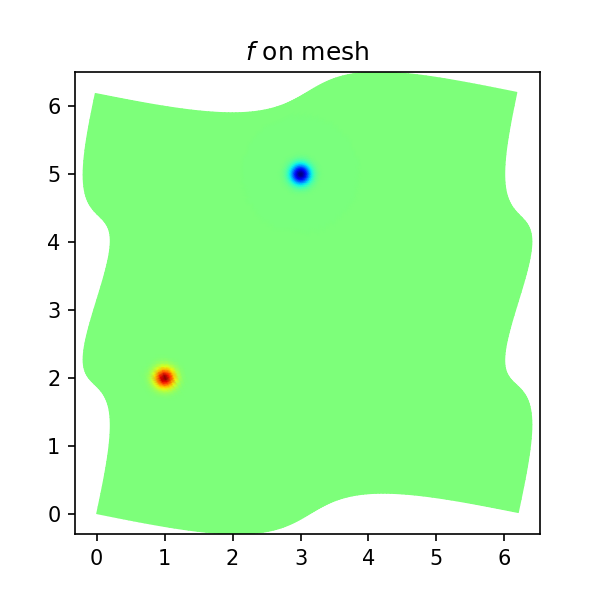
To solve on this grid, replace step 1 above by evaluating the Euler-Fourier formula using the quadrature scheme, which needs a type-1 NUFFT, and step 3 (evaluation on the nonuniform grid) by a type-2 NUFFT. Step 2 (the frequency filter) remains the same. Here is the demo code:
tol = 1e-12                               # NUFFT precision
for n in range(80, 240 + 40, 40):         # convergence study of grid points per side
    t = 2 * np.pi * np.arange(n) / n      # 1d unif grid
    tt, ss = np.meshgrid(t, t)
    xxx = deform(tt, ss)
    xx, yy = xxx[0], xxx[1]               # 2d NU pts
    J = deformJ(tt.T, ss.T)
    detJ = np.linalg.det(J).T
    ww = detJ / n**2                      # 2d quadr weights, including 1/(2pi)^2 in E-F integr
    f = src(xx, yy)
    Nk = 0.5 * n
    Nk = int(2 * np.ceil(Nk / 2))         # modes to trust due to quadr err
    fhat = finufft.nufft2d1(xx.ravel(), yy.ravel(), (f * ww).ravel().astype(np.complex128),
                            n_modes=(Nk, Nk), isign=1, eps=tol, modeord=1);  # do E-F
    k = np.fft.fftfreq(Nk) * Nk           # Fourier mode grid
    kx, ky = np.meshgrid(k, k)
    kfilter = 1. / (kx**2 + ky**2)        # -(Laplacian)^{-1} in Fourier space
    kfilter[0,0] = 0                      # kill the zero mode (even if inconsistent)
    kfilter[Nk//2,:] = 0
    kfilter[:,Nk//2] = 0                  # kill Nk/2 modes since non-symm
    u = finufft.nufft2d2(xx.ravel(), yy.ravel(), (kfilter * fhat),
                        isign=-1, eps=tol, modeord=1).real.reshape((n,n))  # eval filt F series @ NU
    print(f"n={n}:\t\tNk={Nk}\tu(0,0) = {u[0,0]:.15e}")   # check conv at a point
Here a convergence parameter (Nk = 0.5*n) had to be set to
choose how many modes to trust with the quadrature. Thus n is about
twice what it needed to be in the uniform case, accounting for the stretching
of the grid.
The convergence is again spectral, down to at least tol,
and matches the FFT solution at the test point to 12 relative digits:
n=80:         Nk=40   u(0,0) = 1.549914931081811e-03
n=120:        Nk=60   u(0,0) = 1.549851996895389e-03
n=160:        Nk=80   u(0,0) = 1.549852191032026e-03
n=200:        Nk=100  u(0,0) = 1.549852191076891e-03
n=240:        Nk=120  u(0,0) = 1.549852191077001e-03
fig, ax = plt.subplots(1, 2, figsize=[10, 4], dpi=150)
pcolormesh_args = {"shading": "gouraud", "cmap": "jet"}
cax = ax[0].pcolormesh(xx, yy, f, norm=CenteredNorm(), **pcolormesh_args)
fig.colorbar(cax, ax=ax[0])
ax[0].set_xlabel("$x$")
ax[0].set_ylabel("$y$")
ax[0].set_title("source term $f$")
ax[0].axis("equal")
cax = ax[1].pcolormesh(xx, yy, u, norm=CenteredNorm(), **pcolormesh_args)
fig.colorbar(cax, ax=ax[1])
ax[1].set_xlabel("$x$")
ax[1].set_ylabel("$y$")
ax[1].set_title("NUFFT solution $u$")
ax[1].axis("equal")
fig.tight_layout()
plt.savefig("pois_nufft_python.png")
plt.show()

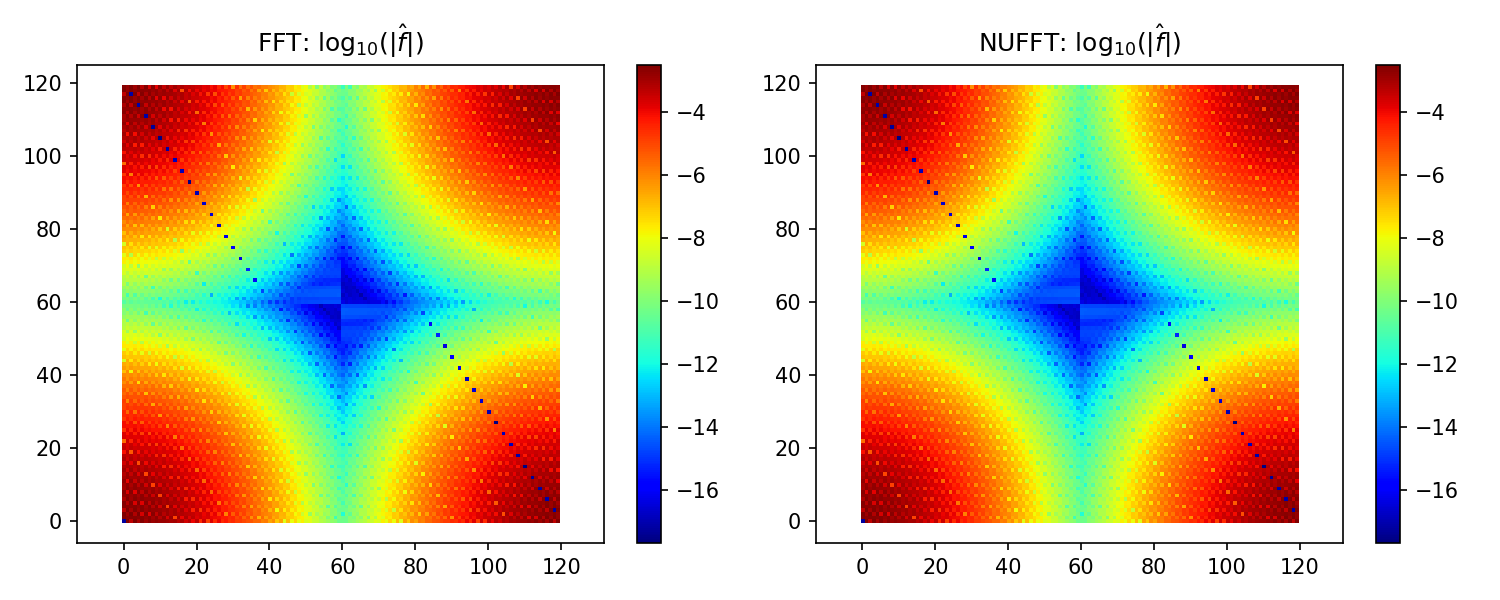
Finally, here is the decay of the modes \(\hat{f}_k\) on a log plot, for the
FFT and NUFFT versions. They are identical down to the level tol:
fig, ax = plt.subplots(1, 2, figsize=[10, 4], dpi=150)
cax = ax[0].imshow(np.log10(np.abs(fhat)), origin="lower", cmap="jet")
fig.colorbar(cax, ax=ax[0])
ax[0].set_title(r"FFT: $\mathrm{log}_{10}(|\hat{f}|)$")
ax[0].axis("equal")
cax = ax[1].imshow(np.log10(np.abs(fhat)), origin="lower", cmap="jet")
fig.colorbar(cax, ax=ax[1])
ax[1].set_title(r"NUFFT: $\mathrm{log}_{10}(|\hat{f}|)$")
ax[1].axis("equal")
fig.tight_layout()
plt.savefig("pois_fhat_python.png")
plt.show()
The full code is at tutorial/poisson2dnuquad.py.
Note
If the non-Cartesian grids were of tensor product form,
one could instead exploit 1D NUFFTs for the above, and, most likely
the use of BLAS3 (ZGEMM with an order-n dense NUDFT matrix) would be
optimal.
Note
Using the NUFFT as above does not give an optimal scaling scheme in the case of a fully adaptive grid, because all frequencies must be handled up to the highest one needed. The latter is controlled by the smallest spatial scale, so that the number of modes needed, \(N\), is no smaller than the number in a uniform spatial discretization of the original domain at resolution needed to capture the smallest features. In other words, the advantage of full adaptivity is lost when using the NUFFT, and one may as well have used the FFT with a uniform Cartesian grid. To remedy this and recover linear complexity in the fully adaptive case, an FMM could be used to convolve \(f\) with the (periodized) Laplace fundamental solution to obtain \(u\), or a multigrid or direct solver used on the discretization of the Laplacian on the adaptive grid.